
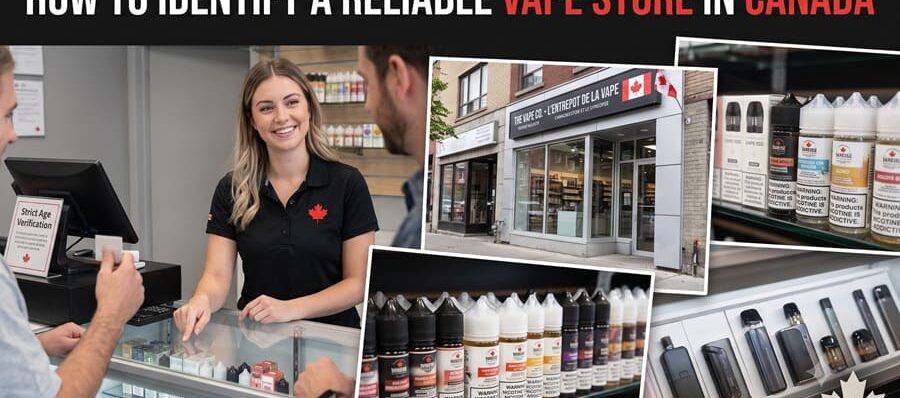
How to Identify a Reliable Vape Store in Canada: 7 Things to Check
Canada’s vaping market is regulated, but that does not mean every retailer follows the same standards. A useful way to evaluate a store is to look beyond brand selection and discounts and check whether the retailer is transparent about the products it sells, follows federal and provincial rules, and gives customers enough information to make an informed decision.
This matters because vaping products sold in Canada are subject to federal requirements covering nicotine concentration, labelling, packaging, promotion and excise stamping. Health Canada’s vaping-product regulations provide the baseline, while provinces and territories may impose additional rules, including minimum-age requirements and restrictions on sales or flavours.
1. Start With Regulatory Compliance
Legal compliance should be the starting point, not a marketing claim. Under federal rules, vaping products manufactured or imported for sale in Canada may contain no more than 20 mg/mL of nicotine. Products displaying nicotine concentrations above that limit should raise an immediate red flag.
Retailers should also carry products with the required labelling and packaging information. Health Canada states that legal nicotine-containing vaping products must meet requirements for items such as nicotine concentration statements, health warnings, ingredient information and child-resistant packaging where applicable. Health Canada explains these consumer-safety requirements here.
2. Check for the Appropriate Vaping Excise Stamp
A vaping excise stamp is another practical authenticity and compliance check. The Canada Revenue Agency says packaged vaping products entering the Canadian duty-paid market generally must carry an appropriate vaping excise stamp. The stamp indicates that applicable duties have been paid and also helps distinguish legal products from contraband.
The stamp can vary by jurisdiction. In provinces participating in the coordinated vaping-duty system, the stamp identifies the province where the product is intended to be sold. The CRA provides an overview of vaping excise stamps and their purpose.
3. Look for Detailed, Specific Product Information
A strong product page should do more than repeat a flavour name and a puff-count claim. Useful information can include the nicotine concentration, device type, e-liquid volume, battery details, whether the device is rechargeable, manufacturer or brand identification, and the required warnings or packaging information.
Puff counts should be treated as estimates rather than guarantees. Draw length, frequency of use, battery behaviour and device design can all affect real-world use. Retailers that present estimates as exact outcomes make it harder for buyers to compare products realistically.
4. Verify Age-Checking and Shipping Practices
A retailer selling regulated vaping products should have a clear process for restricting sales to people who meet the legal minimum age in the relevant province or territory. Online age checks may occur at account creation, checkout, delivery or through a combination of steps.
Because age-of-sale rules and other restrictions can vary across Canada, a retailer should explain where it ships and what verification may be required. A vague or missing age-verification policy is a reason to look more closely at the business before relying on it.
5. Compare the Store’s Claims With Its Actual Policies
Claims such as “trusted,” “premium” or “authentic” are not very useful on their own. More meaningful signals are written policies that explain shipping charges, taxes, defective-product procedures, returns, privacy practices and customer-support options.
For example, when comparing a vape store Canada website with other retailers, it is more useful to examine concrete details such as product labelling, compliance information, age restrictions, delivery terms and return procedures than to rely on promotional language or star ratings alone. The same standard should be applied to any retailer.
6. Be Cautious With Products That Do Not Match Canadian Requirements
Products sold through international marketplaces, social-media sellers or informal channels may not have been packaged for the Canadian market. Warning signs can include nicotine strengths above the federal limit, missing bilingual labelling, missing health warnings, no excise stamp where one is required, or packaging that looks inconsistent with the manufacturer’s normal presentation.
Health Canada also advises consumers to pay attention to legal-product packaging and safety features. Its vaping product safety guidance is a useful reference when checking whether a product’s labelling and packaging appear consistent with Canadian requirements.
7. Evaluate Customer Service Before There Is a Problem
Customer service is easiest to judge when a retailer explains its processes before a purchase is made. Look for a working contact method, realistic response expectations and a written process for damaged, leaking or defective products.
This does not mean every opened vaping product will be returnable. Health, safety and product-category restrictions can limit returns. The important point is whether the retailer clearly explains what it will and will not do when an order arrives damaged or a device fails immediately.
A Practical Checklist for Evaluating a Canadian Vape Retailer
- The store clearly states that sales are age-restricted and explains how age verification works.
- Nicotine-containing products do not exceed the federal 20 mg/mL concentration limit.
- Product pages include meaningful specifications rather than only marketing language.
- Products carry the required Canadian labelling and packaging information.
- Vaping products have the appropriate excise stamp where required.
- Shipping charges, taxes and delivery restrictions are explained before checkout.
- Defective-product, return and customer-support policies are easy to find.
- The retailer provides a verifiable business identity and a working way to contact customer service.
Frequently Asked Questions
What is the maximum legal nicotine concentration for vaping products in Canada?
The federal maximum is 20 mg/mL for vaping products manufactured or imported for sale in Canada. Health Canada’s Nicotine Concentration in Vaping Products Regulations also prohibit packaging and selling a vaping product if the nicotine concentration displayed on the package exceeds 20 mg/mL.
Do vaping products sold in Canada need an excise stamp?
Generally, packaged vaping products entering the Canadian duty-paid market must carry an appropriate vaping excise stamp. The CRA explains that the stamp shows applicable duties have been paid. There are limited exceptions for certain categories, so consumers should use the CRA guidance when checking a particular product.
Does a large product selection mean a vape retailer is reliable?
Not necessarily. Product range can be useful, but compliance, accurate product information, age verification, transparent policies and traceable customer service are stronger indicators than the number of brands or flavours listed.
Can vaping rules differ by province?
Yes. Federal law sets important national requirements, but provinces and territories can impose additional rules, including minimum-age requirements, retail restrictions, flavour limits and taxation. A retailer should make clear which jurisdictions it serves and which restrictions apply.
Final Takeaway
A reliable Canadian vape retailer should be easy to verify. The strongest indicators are not slogans or large inventories but visible compliance with Canadian rules, accurate product information, appropriate excise stamps, meaningful age controls, transparent pricing and clear support policies.
Consumers should also remember that vaping is not risk-free, and nicotine is addictive. People who do not currently use tobacco or vaping products should not start. Adults who use vaping products should check current federal, provincial and territorial requirements because rules can change.
Authorities & Sources
- Health Canada — Vaping products regulations — Federal rules covering labelling, packaging, promotion and nicotine concentration.
- Health Canada — Vaping product safety — Consumer guidance on legal product packaging, nicotine concentration and safety information.
- Health Canada — About vaping — General information about vaping and nicotine in Canada.
- Canada Revenue Agency — Overview of vaping excise stamps — Current information on vaping excise stamps and the coordinated duty system.
- Canada Revenue Agency — Excise stamps: Information for consumers — Consumer-facing guidance for identifying excise stamps.
Disclaimer
This article is for general informational purposes only and is not legal, medical or regulatory advice. Vaping laws and retail requirements can differ by province or territory and may change. Verify current rules with Health Canada, the Canada Revenue Agency and the relevant provincial or territorial authority. Vaping is not risk-free, nicotine is addictive, and vaping products should be kept away from children and youth.